
Top 5 AI Observability Tools to Watch in 2025
10/15/2025 2025-10-15 23:10Top 5 AI Observability Tools to Watch in 2025
Artificial intelligence is no longer an experiment sitting in research labs — it’s now deeply embedded in the systems that power our world.
From healthcare diagnostics to financial forecasting and logistics automation, AI is quietly influencing decisions that impact millions every day.
But as these models scale, a single undetected anomaly or subtle data drift can turn automation into chaos — leading to costly mistakes, compliance breaches, or even public backlash.
That’s where AI observability comes in.
Once considered a niche MLOps add-on, it has now become a mission-critical layer for any organization serious about reliability, transparency, and governance in AI operations.
🧠 Why AI Observability Matters
AI observability is not just about tracking performance metrics.
It’s about understanding why your model behaves a certain way, when it fails, and how those failures impact real-world outcomes.
For modern businesses, it’s no longer optional — it’s the foundation of trust and accountability in AI-driven decision-making.
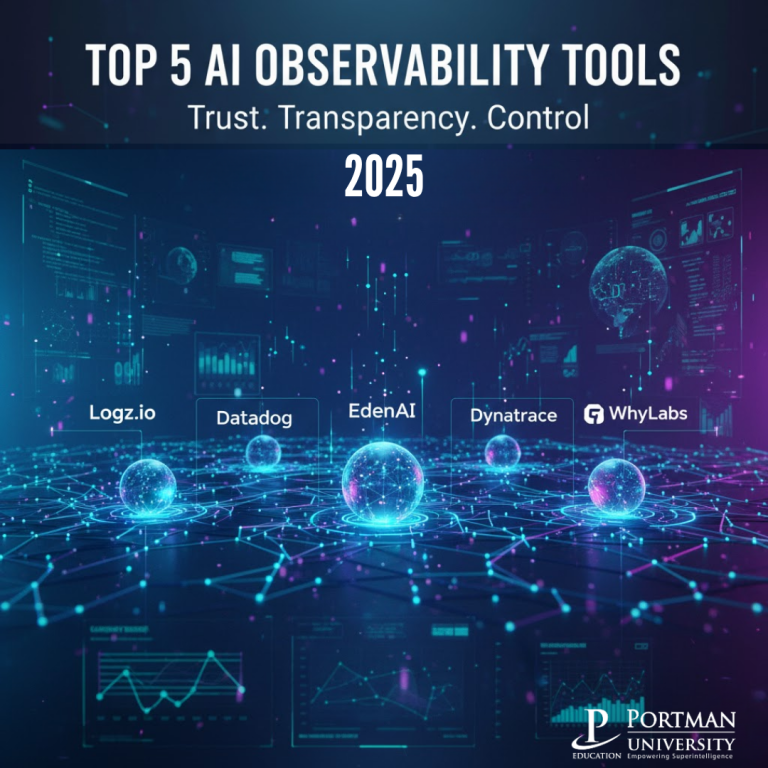
✨ The Top 5 Tools Leading AI Observability in 2025
🧭 1. Logz.io — Intelligent Troubleshooting for Cloud-Native AI
Logz.io brings a unified, cloud-native observability platform that combines logs, traces, and metrics under one roof.
Its AI-driven root cause analysis automatically detects anomalies, explains issues in plain language, and guides even junior engineers through troubleshooting workflows — saving valuable response time.
🧩 2. Datadog — Full-Stack Visibility for AI Pipelines
Evolving from a traditional monitoring tool into an AI observability powerhouse, Datadog tracks data drift, model bias, and inference performance across platforms like TensorFlow, PyTorch, and MLflow.
With customizable dashboards and alerts, teams gain full visibility from model training to deployment — all within one unified interface.
🌐 3. EdenAI — Vendor-Agnostic Observability Across Clouds
For enterprises managing multiple AI providers, EdenAI delivers a centralized control hub.
It monitors AI models, APIs, and endpoints across clouds, detecting performance degradation or drift in real time — no matter which vendor or framework is used.
Its compliance-ready reporting makes it ideal for large organizations with strict governance needs.
⚙️ 4. Dynatrace — Predictive Monitoring with the Davis® AI Engine
Dynatrace extends its autonomous DevOps legacy into AI observability.
Its Davis® AI engine proactively detects model drift, dependency failures, and system bottlenecks before they impact users.
Through predictive analytics and topological mapping, teams can anticipate failures and act before they escalate.
📊 5. WhyLabs — Data-Centric Observability for Responsible AI
WhyLabs focuses on the data that drives your AI.
It continuously monitors schema changes, feature drift, and predictive bias — ensuring every deployed model performs accurately and ethically.
Its intuitive dashboards and collaborative workflows make governance and audit trails simple to maintain.
🌍 The Bigger Picture
When AI observability is done right, businesses move from reaction to prevention.
Hospitals avoid misdiagnoses, fintechs prevent bias, and customer service teams detect inefficiencies before they impact satisfaction.
AI observability doesn’t just protect your models — it protects your brand, customers, and future scalability.
🚀 Final Takeaway
AI observability isn’t about watching numbers — it’s about seeing clearly.
The organizations that truly understand their AI will be the ones that lead the next wave of intelligent business.
Search